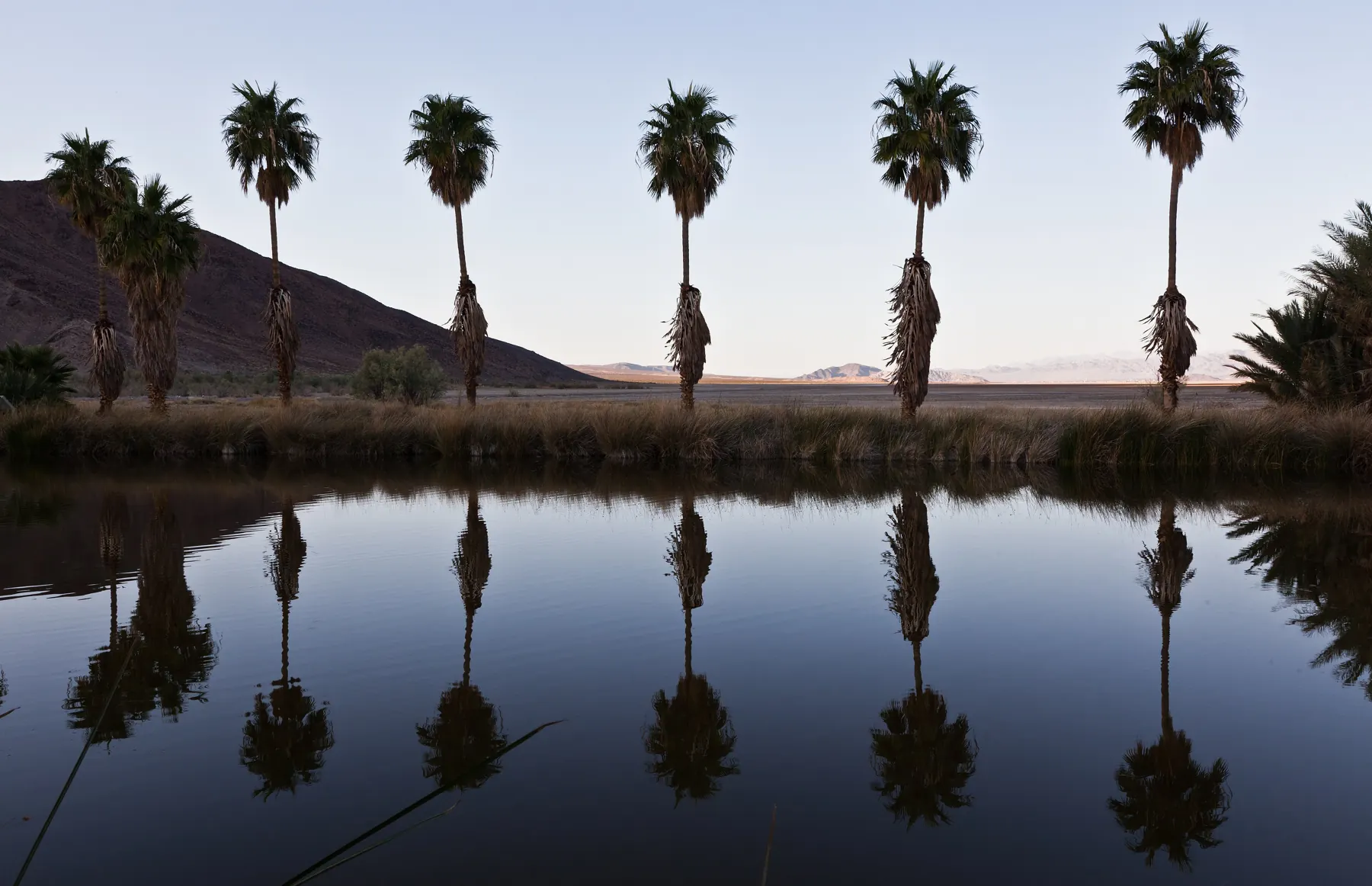
Curtis Howe Springer built four guest buildings with 59 units, a chapel, a bathhouse with small mineral baths laid out in a cross, a radio studio, an airstrip and an artificial lake in the Mojave Desert. He never owned the land under any of it. For thirty years he held it on paper as a set of mining claims, using a nineteenth-century law written for prospectors with picks and pans.
How did that work, and why did it take the government so long to undo it? This post walks through the law, Springer's argument and the court cases that ended Zzyzx.
The law: the General Mining Act of 1872
The General Mining Act, approved on May 10, 1872, governs prospecting and mining for "locatable" minerals, such as gold, silver and copper, on federal public lands. It grew out of the informal rules miners worked out during the California Gold Rush. In broad terms, a U.S. citizen can locate a claim on federal land open to mineral entry once a valuable mineral has been discovered, and must keep working the claim to hold it.
The key point, as Wikipedia's account of Springer explains, is that a mining claim does not make the land private. It stays public land unless and until the claimant proves to government geologists that it holds minerals that can be extracted at a profit and obtains a patent. A claim gives a right to mine, not a right to build a resort.
Springer's filing: September 13, 1944
Springer's own version of the founding appears in a 1984 piece he wrote for the Baker Valley News, quoted at length by The Mojave Project. He, his wife, his father and a man named Jack Renie camped at the old Fort Soda site in September 1944, set up rock monuments and drove to the county seat in San Bernardino. There they learned the land belonged to "good old Uncle Sam."
Because each person could claim only a limited number of acres, Springer wrote, he got friends and relatives to join the filing. Together they claimed 12,800 acres, a tract the Los Angeles Times described as eight miles long and three miles wide. The Mojave Project reports that Springer understood he would have the option to buy the land after five years of mining activity.
"Did almost everything but mine"
Then he built. Over the next decades the claims filled with a hotel, a dining hall, a chapel, a library, pools, a goat shed, rabbit pens, an airstrip he called "Zyport" and a palm-lined "Boulevard of Dreams." According to Wikipedia, by the late 1960s he had begun marking off lots and letting large donors to his ministry build homes on them. That drew federal attention fast, because it looked like selling public land.
The government's view was summed up in a line from a 1974 Los Angeles Times report quoted by The Mojave Project: officials found that "Springer did almost everything but mine."
Springer argued the opposite. In his 1984 Baker Valley News essay "The Legal Rape of Zzyzx," he said the old U.S. Land Office had never required any particular mineral, and that harvesting salts from Soda Dry Lake for his health products counted as mining. "There was no mention of the mining of gold," he wrote. "We were seeking minerals for both internal and external therapeutic purposes."
The government moves
The case became public in 1967. On July 14 of that year, the Los Angeles Times ran Charles Hillinger's story "'Squatter' Owes Rent, U.S. Says," reporting that the Bureau of Land Management considered Springer a "super squatter" with no authority to use the land for a resort. The BLM was seeking $34,187 in damages and back rent.
The court record is unusually clear, and it is public domain. In the federal ejectment case:
- December 15, 1970: In United States v. Springer, 321 F. Supp. 625, the district court described what stood on the claims: "four guestroom buildings aggregating 59 units, a dining room with kitchen facilities, an administration building, a chapel-meeting room, indoor and outdoor mineral baths," plus facilities for making "health" foods and preparing printed materials and radio tapes. The court entered a partial summary judgment on December 18, 1970.
- June 18, 1971: The court issued a preliminary injunction barring the Springers from using the land for anything but mining. It specifically banned renting rooms, packaging food products under the "Zzyzx" name, printing literature and recording radio programs there.
- November 30, 1972: The Ninth Circuit affirmed that injunction in United States v. Springer, 478 F.2d 43, and denied rehearing on March 5, 1973. A footnote lists Springer's earlier attempts to get the land under other laws: a desert land application in 1951, recreation and public purposes applications in 1957–58 and a non-mineral application in 1966. All failed.
- November 14, 1972: The Interior Board of Land Appeals ruled that Springer's ten mining claims, nine placer claims and one lode claim, were invalid because no valuable mineral had ever been discovered.
- March 6, 1973: The district court entered summary judgment declaring that the Springers had no right, title or interest in the land and ordering their ejectment.
- January 17, 1974: The Ninth Circuit affirmed in United States v. Springer, 491 F.2d 239, and denied rehearing on February 26, 1974.
The 1974 opinion went straight to Springer's salt-mining theory. His products, the court noted, "were not sold. They were distributed gratis to persons asking for them. Support came in the form of voluntary donations resulting from Dr. Springer's radio appeals. These activities cannot by any stretch of the imagination be considered the mining of valuable minerals."
One detail surprises most readers. Popular accounts, including the Los Angeles Times, give the size of Springer's domain as 12,800 acres. The 1974 opinion describes the ten contested claims as supporting possession of "several hundred acres of public domain." The 12,800-acre figure comes from Springer's original 1944 filing as he told it, not from the court record.
The Mojave Project credits the eviction order to U.S. District Judge Francis C. Whelan. Wikipedia reports, citing Weird California, that Springer offered to pay the $34,187 but the government refused.
The end, and what replaced it
On April 11, 1974, Springer was removed from the property. The Mojave Project says he was given thirty-six hours to clear out what he had built over three decades. See April 11, 1974.
The land went back to the public in practice as well as on paper. In 1976 the BLM and the California State University agreed to manage the former resort jointly as the Desert Studies Center. In 1994 the California Desert Protection Act created Mojave National Preserve, and today the National Park Service is the federal partner at Zzyzx. See from health spa to field station.
Why it took thirty years
Springer's story is extreme, but the gap it exploited was real. Mining claims on federal land were cheap to file and slow to challenge, and challenging one meant proving a negative: that there was no valuable mineral deposit. Springer also had a following, a newspaper column and a gift for making any government action look like persecution. His supporters in Baker pointed out that he built and maintained Zzyzx Road and that, after his eviction, the BLM closed the road to the public for years.
The law that let him in was meant to reward people who dug things out of the ground. Springer dug a lake, planted palms and sold salt by mail, and he held on long enough that a federal court had to spell out the difference.
Sources
- General Mining Act of 1872. Wikipedia: en.wikipedia.org/wiki/General_Mining_Act_of_1872
- Curtis Howe Springer. Wikipedia (claims remain public land until validated; donor lots; $34,187 offer, citing Weird California, 2006): en.wikipedia.org/wiki/Curtis_Howe_Springer
- Aurora Tang, "Zzyzx: Revisiting Doc Springer's Boulevard of Dreams," The Mojave Project (2015), quoting Springer's 1984 Baker Valley News pieces, Hillinger's July 14, 1967 Los Angeles Times story and the April 12, 1974 Los Angeles Times: mojaveproject.org/dispatches-item/zzyzx-dr-springer/
- United States v. Springer, 321 F. Supp. 625 (C.D. Cal. 1970): openjurist.org/478/f2d/43 (quotes the district court opinion)
- United States v. Springer, 478 F.2d 43 (9th Cir. Nov. 30, 1972; rehearing denied Mar. 5, 1973): openjurist.org/478/f2d/43
- United States v. Springer, 491 F.2d 239 (9th Cir. Jan. 17, 1974; reh'g denied Feb. 26, 1974): openjurist.org/491/f2d/239
- Charles Hillinger, "Zzyzx Rises Above Its Shady, Colorful Past," Los Angeles Times, Sept. 30, 1990: www.latimes.com/archives/la-xpm-1990-09-30-vw-2058-story.html
- Zzyzx, California. Wikipedia (1976 BLM–CSU agreement; 1994 California Desert Protection Act): en.wikipedia.org/wiki/Zzyzx,_California
Spotted an error? Tell us and we will correct it.