Most frauds leave nothing behind but paperwork. Curtis Howe Springer left a campus. The hotel wings, dining hall, chapel and spring-fed lake he built at Zzyzx between 1944 and 1974 are now the CSU Desert Studies Center, one of the busiest desert field stations in the American West. Here is how that happened and what goes on there now.
A resort with no owner
When the federal courts ended Springer's occupation in 1974, the government was left with a strange inheritance. Springer had never owned the land, as our mining law post explains, but he had covered it with buildings. There were guest rooms, a pool, an airstrip, ponds and a palm-lined boulevard, all on federal land managed by the Bureau of Land Management.
Tearing everything down was one option. According to The Mojave Project, the BLM considered several proposals for the site, including returning Soda Springs to its earlier state, and the Mojave historian Dennis Casebier said bulldozers stood ready. An endangered fish in the ponds, the Mohave tui chub, made it impossible to simply erase the place, and the university system offered a better use.
1976: the universities move in
In 1976, the Bureau of Land Management and the California State University agreed to manage the land at and around Zzyzx together and to establish the Desert Studies Center. When Congress passed the California Desert Protection Act of 1994, it created the Mojave National Preserve out of former BLM land. Zzyzx sits on the preserve's western edge, and the act formalized the partnership between the National Park Service and the center.
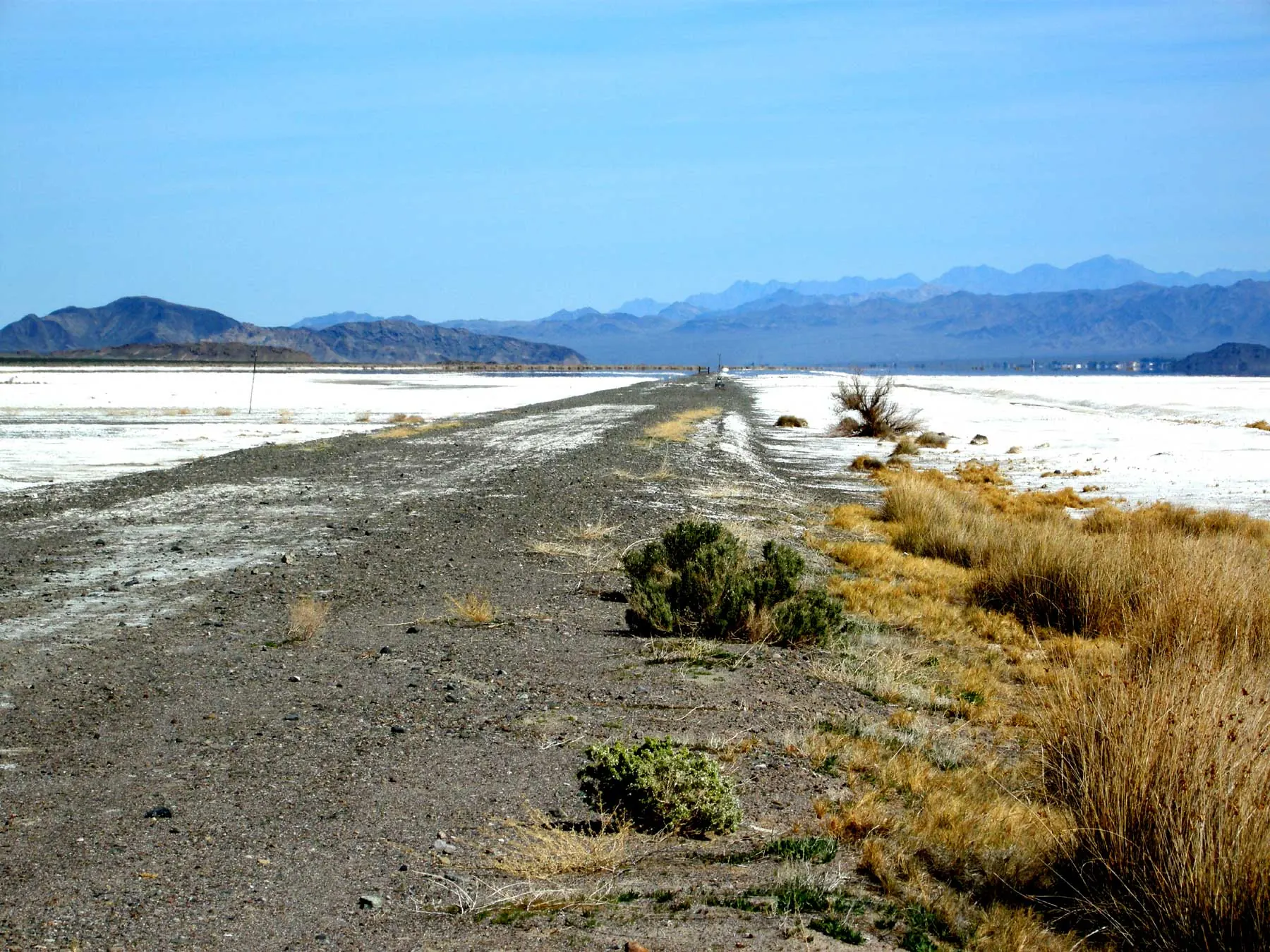
The center describes itself today as a 1,280-acre field station on the shore of Soda Dry Lake at the end of the Mojave River. It is a satellite campus of the CSU, governed by the California Desert Studies Consortium: faculty and administrators from seven southern California CSU campuses, at-large members and representatives of the National Park Service.
What the place is for
The center's own description explains why scientists value the location. Within easy reach are alkali salt flats, creosote-bush lowlands, Joshua tree forests, rocky slopes, lava flows and sand dunes. Few places offer that range of desert habitats near a single set of buildings with beds and a lab.
The facilities can lodge up to 75 people. They include meeting rooms, a classroom, a laboratory, a small library, natural history collections and outdoor meeting spaces. Class groups come for field trips in geology, biology, ecology and archaeology, and researchers use it as a base for work across the broader Mojave.
The buildings are reused, not replaced. The Los Angeles Times reported in 2002 that students and educators used the resort's old chapel as a classroom and Springer's private office as a library. The man who called himself a doctor without a degree now has his office full of real scholarship.
Water, fish and long-term science
The springs that drew the Mohave and Chemehuevi people, the 1860s Army and later Springer are still the center's most important feature. Lake Tuendae and the small MC Spring hold one of the few remaining populations of genetically pure Mohave tui chub, an endangered fish, and the National Park Service and U.S. Geological Survey have used Zzyzx as a reference point for efforts to establish new populations. The water that Springer sold as a cure turned out to be valuable as habitat.
A land acknowledgment
The center states that it is located on the traditional and ancestral lands of the Chemehuevi people of the Southern Paiute (Nuwuvi) territory, lands of great historical, spiritual and personal significance to their original inhabitants. The NPS notes that the springs were used by the Mohave and Chemehuevi people for many generations before explorers, soldiers or Springer arrived. See Soda Springs before Springer for that longer history.
Can you visit?
Only in part. The center itself is closed and off-limits to the public without a reservation. Anyone can drive Zzyzx Road and walk the NPS's Lake Tuendae Trail in daylight, and from the trail you can see the old resort buildings across the water. Our visiting guide covers the rules: no camping, drones or pets, and no entering the campus.
The best ending
There is a satisfying symmetry in it. Springer sold a version of science: crystals, teas and "nerve food," backed by fake degrees and radio patter. What replaced him is real science, done by students and researchers on the same ground. If Zzyzx really is "the last word," it belongs to them.
Sources
- CSU Desert Studies Center, home page (1,280 acres; lodging for 75; established 1976; consortium; land acknowledgment): www.fullerton.edu/dsc/
- CSU Desert Studies Center, "Visiting": www.fullerton.edu/dsc/visiting/
- Zzyzx, California. Wikipedia (1976 BLM–CSU agreement; 1994 California Desert Protection Act): en.wikipedia.org/wiki/Zzyzx,_California
- National Park Service, "Zzyzx," Mojave National Preserve: www.nps.gov/moja/learn/historyculture/zzyzx.htm
- Cecilia Rasmussen, "Zzyzx: An Unlikely Home of Hucksterism and Miracle Cures," Los Angeles Times, June 16, 2002: www.latimes.com/archives/la-xpm-2002-jun-16-me-then16-story.html
- Aurora Tang, "Zzyzx: Revisiting Doc Springer's Boulevard of Dreams," The Mojave Project (2015): mojaveproject.org/dispatches-item/zzyzx-dr-springer/
- U.S. Geological Survey, "Evaluating Potential Refugia for the Endangered Mohave Tui Chub": www.usgs.gov/centers/nevada-water-science-center/science/evaluating-potential-refugia-endangered-mohave-tui-chub
Spotted an error? Tell us and we will correct it.