Timeline
From soldiers’ redoubt to field station
Every date below links to its source. Court dates come from the published federal opinions.
This page is a date strip, not the story. Each row is one claim with one citation. If you want scenes, read the narrative. If you want the legal theory, read the 1974 page. The strip is here so a date can be checked without rereading an essay.
Two published numbers on this strip do not match, and the rows do not hide that. Springer’s own acreage talk, carried by The Mojave Project, is 12,800 acres. The 1974 appellate opinion speaks of the operation in a much smaller frame. The station count splits the same way: 221 in the United States and 102 abroad in the 2002 Los Angeles Times, against “over 300” worldwide on the park service page. The false-advertising count splits too: eighteen in the 1972 federal footnote, eight in the Mojave Project’s telling. The strip keeps the conflict instead of averaging it.
The early rows are not Springer at all. Hancock’s Redoubt and the short-lived Fort Soda are Army facts from Hart’s Digital-Desert note on the Government Road. The Tonopah and Tidewater years are a railroad that passed the lake and left a grade. Springer is born in 1896, decades before he files anything here. Treating 1944 as the beginning of the place is his version. The strip starts earlier because the water started earlier.
- Before Springer
- 1860
Hancock’s Redoubt
Men of the 1st Dragoons build a small camp at Soda Springs to guard travelers on the Government Road.
Source: Hart / Digital-Desert
- 1867 to 1868
“Fort Soda”
The Army keeps an outpost of Camp Cady at the springs from Aug. 21, 1867, to May 23, 1868, then leaves for good.
Source: Hart / Digital-Desert
- 1896Dec. 2
Curtis Howe Springer is born
He will later sell sheet music at Billy Sunday revivals and drum up crowds for William Jennings Bryan.
Source: Wikipedia
- 1907 to 1940
The Tonopah & Tidewater Railroad
The borax railroad runs past Soda Lake. Its grade still crosses the site.
Source: Wikipedia
- The radio years
- 1934
Turned away by WGN
Chicago’s WGN checks with the AMA and declines him. He broadcasts twice daily on WCFL instead.
Source: Wikipedia
- 1935Sept. 14
“A Quack and His Nostrums”
The AMA’s Bureau of Investigation profiles Springer in JAMA: no degree found, Re-Hib mostly baking soda.
Source: JAMA 105(11):900
- The kingdom
- 1944
The last word
Springer files mining claims at Soda Springs, by his account on 12,800 acres, and renames the place Zzyzx.
Source: The Mojave Project
- 1944 to 1974
Building the kingdom
Four guest buildings with 59 units, a chapel, indoor and outdoor mineral baths (small soaking pools laid out in a cross), a recording studio, the Zyport airstrip and Lake Tuendae.
- Peak
221 stations
His program airs on 221 U.S. stations and 102 abroad. The NPS puts it at over 300 worldwide.
Source: Los Angeles Times
- The reckoning
- 1967July 14
“Super squatter”
The BLM seeks $34,187 in damages and back rent, according to the Los Angeles Times.
Source: The Mojave Project
- 1968Nov.
Arrested
California charges false advertising. The Ninth Circuit later lists eighteen counts of false advertising among his convictions, some on guilty pleas (The Mojave Project says eight).
Source: 478 F.2d 43, 46 n.2
- 1970Oct. 13
An endangered fish
The Mohave tui chub is federally listed as endangered. Its last pure populations live at Soda Springs.
Source: U.S. Fish & Wildlife Service
- 1970Dec. 15
The district court rules
A federal judge finds the resort, with 59 guest units, can’t be justified as mining (321 F. Supp. 625).
Source: 478 F.2d 43
- 1971June 18
Injunction
The court bars renting rooms, packaging “Zzyzx” foods, printing literature and recording radio shows on the land.
Source: 478 F.2d 43
- 1972Nov.
Claims invalid
Interior’s land appeals board voids all ten claims (Nov. 14). The Ninth Circuit upholds the injunction (Nov. 30).
Source: 478 F.2d 43
- 1973Mar. 6
Ejectment ordered
Summary judgment: the Springers have no right, title or interest in the land.
Source: 491 F.2d 239
- 1974Jan. 17
Affirmed
“[C]annot by any stretch of the imagination be considered the mining of valuable minerals…” Rehearing denied Feb. 26.
Source: 491 F.2d 239
- 1974Apr. 11
The gate closes
Springer is removed from Zzyzx and, by The Mojave Project’s account, given 36 hours to clear out.
Source: The Mojave Project
- After
- 1976
The Desert Studies Center
The BLM and the California State University agree to run the site as a field station.
Source: Wikipedia
- 1984June 14
Official at last
The U.S. Board on Geographic Names approves “Zzyzx” as a place name.
Source: Wikipedia
- 1985Aug. 19
Springer dies
He dies in Las Vegas at 88 and is buried at Riverside National Cemetery.
Source: Wikipedia
- 1994
Mojave National Preserve
The California Desert Protection Act creates the preserve; Zzyzx sits on its western edge.
Source: Wikipedia
- Today
Lake Tuendae
A quarter-mile public trail circles the lake Springer dug, still home to the endangered tui chub.
Source: National Park Service
What the gaps are
The long empty stretches are part of the record. From the Army’s departure in 1868 to the mining filings in 1944, this strip does not pretend to list every cattle camp, survey, or railroad siding. Those years belong to the pre-Springer article and to Duffield-Stoll’s oasis history, not to a row we cannot date. From 1944 to 1967 the resort is operating, and the strip collapses three decades of construction into one row because the guest wings, the cross of baths, the studio, the Zyport strip, and Lake Tuendae are described together in the 1972 opinion and on the Desert Studies Center’s account, not as separate building permits we have in hand.
The court tail looks crowded because it is a stack of stays and affirmances, not because the story gets more dramatic each month. Read those rows as a sequence of permissions being removed: first the injunction, then the claims, then title, then the appeal, and only then the morning the dispatch dates to April 11. The name Zzyzx becomes a federal place name on June 14, 1984, ten years after the removal, which is why the word on the exit sign is not the same event as the word on the mining papers. Springer dies in Las Vegas on August 19, 1985. The preserve arrives in 1994, when the California Desert Protection Act draws a park boundary along this edge of Soda Lake. The last row is the public loop that exists now.
If a row is wrong, the citation is the thing to check, and corrections need the row and a better source. A memory of a visit is welcome. It is not a substitute for the opinion or the park page.
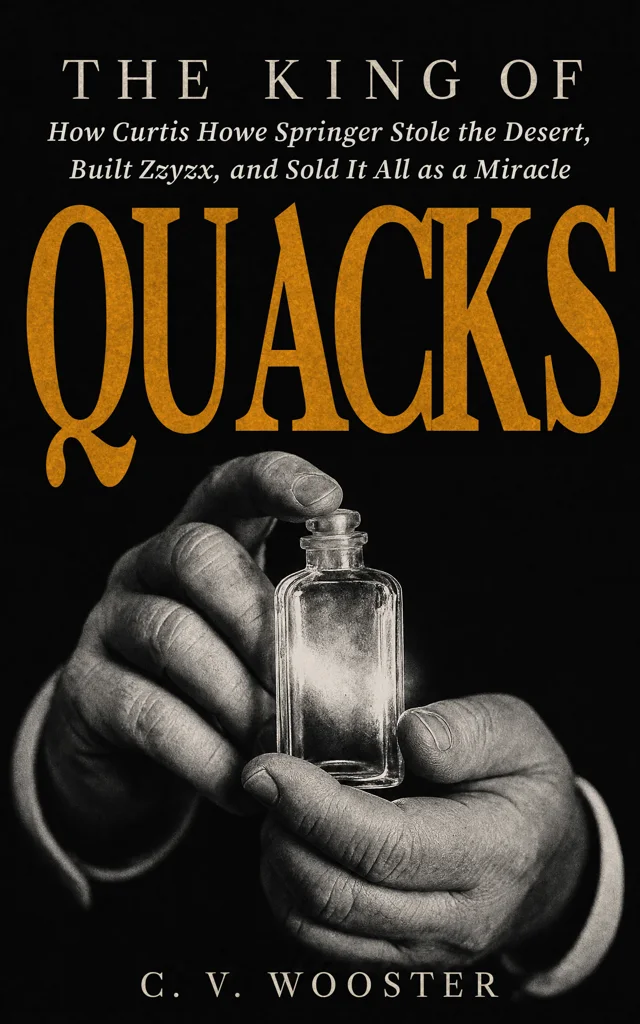
The Kindle edition
The King of Quacks is the true story of the radio preacher who claimed a desert, named it the last word in the dictionary and sold it all as a miracle.
The form opens a message in your own email program to hello@directoryassistancegroup.com. This site does not store the address. See our privacy policy.