Curtis Howe Springer was not the first man to sell health over the radio, or the most outrageous. When he started broadcasting in Chicago in 1934, three other men had already shown how much money a confident voice, a clinic and a microphone could make. Their stories explain the world Springer stepped into, and why he lasted longer than any of them.
John R. Brinkley, the goat-gland doctor
John Romulus Brinkley (1885–1942) had no accredited medical education; he bought his credentials from a diploma mill. In 1918 he opened a clinic in Milford, Kansas, and became famous for implanting goat testicles into men. He first claimed the operation cured impotence, then claimed it helped a wide range of male complaints. He charged $750 per operation. The tissue did not take; the body simply absorbed it as foreign matter.
Brinkley understood radio early. In 1923 he built KFKB in Milford, its call letters glossed as "Kansas First, Kansas Best." He sold his services and "prescriptions" on the air, including a Medical Question Box show in which he diagnosed listeners from their letters.
The backlash came in 1930. The Kansas medical board revoked his license. By the time of that hearing, he had signed death certificates for 42 people. Six months later, the Federal Radio Commission refused to renew KFKB's license, finding its programming was mostly advertising and that the Medical Question Box was against the public interest. The courts upheld the decision in KFKB Broadcasting Association v. Federal Radio Commission, a landmark case in broadcast law.
Brinkley moved across the border. The Mexican government licensed XER at Villa Acuña, across from Del Rio, Texas, and it began broadcasting in October 1931. It was a "border blaster" whose signal reached far into the United States. He also ran for governor of Kansas three times, nearly winning twice. Malpractice, wrongful-death and fraud suits eventually wiped him out, and he died nearly penniless in 1942.
Norman Baker: "Know the Naked Truth"
Norman G. Baker (1882–1958) was a former traveling mind-reading showman and calliope maker from Muscatine, Iowa. His station, KTNT, went on the air in 1925. The letters were said to stand for "Know The Naked Truth."
In 1930 he opened the Baker Institute in Muscatine and advertised a cancer "cure" on KTNT. It was a costly series of injections of common substances, including corn silk, watermelon seeds, clover, water and carbolic acid. On the air he called licensed doctors "educated fools" and said M.D. stood for "More Dough." When JAMA accused him of quackery, he dubbed the AMA the "Amateur Meat-cutters Association."
Regulators closed in. Iowa won an injunction against his practice, upheld by the state Supreme Court in 1931, and KTNT was deleted that year. Baker moved his broadcasting to XENT in Nuevo Laredo, Mexico, and in 1937 reopened as a "hospital" in the old Crescent Hotel in Eureka Springs, Arkansas. Federal mail-fraud charges followed. In January 1940 a court found his cure a "pure hoax," and he served his sentence at Leavenworth from May 1941 to July 1944. He retired to Miami and died in 1958.
Harry Hoxsey and the herbal paste
Harry Hoxsey, a former coal miner and insurance salesman, was Baker's partner in Muscatine before the two fell out and sued each other. His "Hoxsey Therapy" combined a caustic paste for external cancers with an herbal tonic for "internal" ones, plus laxatives and diet rules. He claimed the formula came from his great-grandfather, who supposedly watched a horse cure its own tumor by grazing on wild plants.
Hoxsey opened clinics across the country, at one point 17, often moving one step ahead of charges of practicing medicine without a license. His Dallas clinic, opened in 1936, became one of the largest privately owned cancer centers in the world. He sued JAMA for libel and won, but was awarded $2, because the judge decided his business thrived on claims of AMA persecution. When he submitted 77 case histories to the National Cancer Institute in 1950, only six included tissue biopsies. The FDA banned the sale of his treatment in 1960 as "worthless and discredited." The therapy moved to Tijuana, where it is still marketed.
Where Springer fits
Set beside these men, Springer looks almost modest. He didn't operate on anyone or inject anyone with carbolic acid. His products were mostly teas, salts, vegetable concentrates and laxatives, and as the AMA's Bureau of Investigation and later the federal courts found, his claims were the problem, not his ingredients. That difference may explain his long run:
- He avoided the operating table. Brinkley's and Baker's careers ended under the weight of patients who died. Springer's ended over land and advertising.
- He sold donations, not prices. The Ninth Circuit noted that his products were given in exchange for donations prompted by his radio appeals. That framing kept him in the language of ministry and charity.
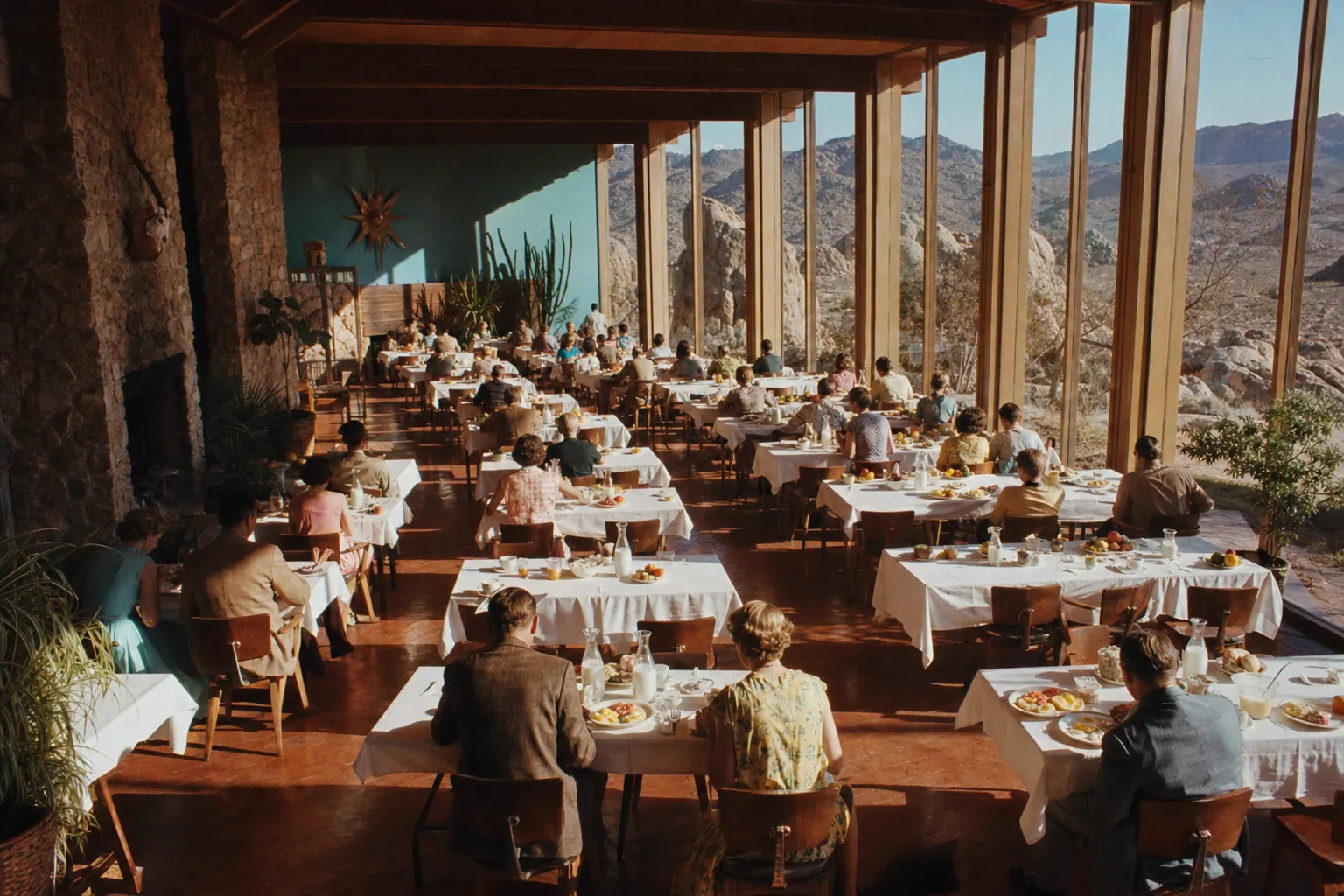
- He built a destination. Zzyzx was a free, faith-based retreat with a bus from Los Angeles. Listeners could visit, and the visit itself became the product.
- He wrapped it in religion. Brinkley and Baker fought the medical establishment head-on. Springer preached, sang and prayed. It is harder to regulate a sermon than a surgery.
All four men shared the same tools: radio, confidence, a story about persecution by the medical establishment, and listeners who were sick, scared and far from a good doctor. Springer called himself the "last of the old-time medicine men." He was certainly the last of this group to fall. Federal action ended his empire in 1974, the same year Hoxsey died.
Sources
- John R. Brinkley. Wikipedia: en.wikipedia.org/wiki/John_R._Brinkley
- KFKB Broadcasting Association v. Federal Radio Commission, 47 F.2d 670 (D.C. Cir. 1931), as summarized in the Brinkley article above.
- Norman G. Baker. Wikipedia: en.wikipedia.org/wiki/Norman_G._Baker
- Hoxsey Therapy. Wikipedia: en.wikipedia.org/wiki/Hoxsey_Therapy
- Curtis Howe Springer. Wikipedia: en.wikipedia.org/wiki/Curtis_Howe_Springer
- United States v. Springer, 491 F.2d 239 (9th Cir. 1974): openjurist.org/491/f2d/239
- Pope Brock, Charlatan: America's Most Dangerous Huckster, the Man Who Pursued Him, and the Age of Flimflam (Crown, 2008). See it on Amazon (affiliate link).
Spotted an error? Tell us and we will correct it.