If you have driven Interstate 15 between Los Angeles and Las Vegas, you have probably seen the sign. A few miles southwest of Baker, a standard green highway placard announces an exit for Zzyzx Rd. Passengers try to say it, the driver laughs, and most people keep going.
The short answer: it is pronounced ZY-zix, rhyming roughly with "Isaacs." Wikipedia gives it as /ˈzaɪzɪks/. Writers spelled it every which way. The Los Angeles Times wrote "Zy-Zix" in 2002 and "Zeye-Zix" in 1990, but the sound is the same. Two syllables, a long "i" in the first one, and a hard "x" at the end.
The longer answer is more interesting, because the word did not exist until 1944. It was made up by one man, for one reason: to be the last word.
A name built to be remembered
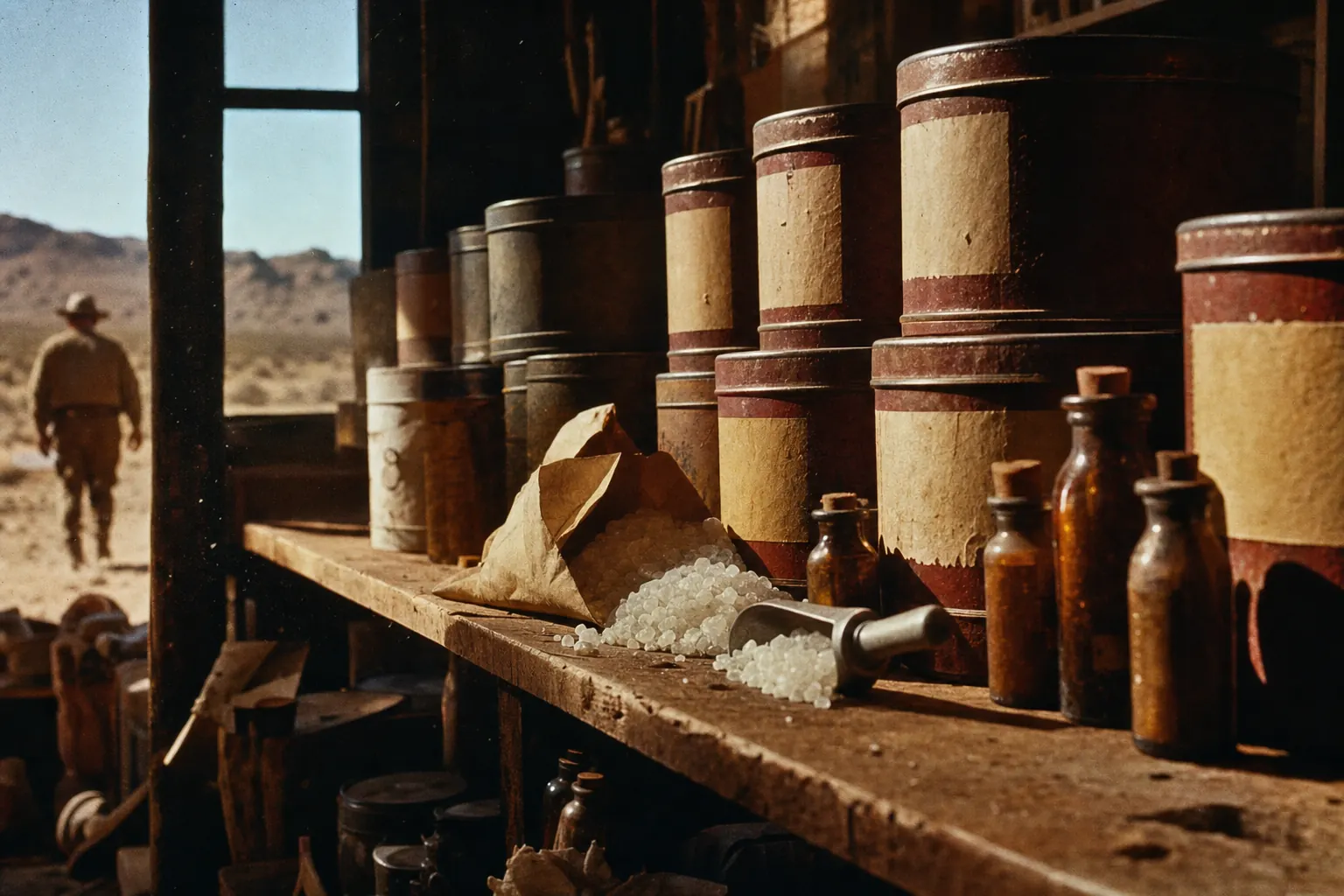
In September 1944, Curtis Howe Springer, a radio evangelist and self-styled doctor, filed mining claims on about 12,800 acres of federal land around a desert oasis called Soda Springs. He soon built a health resort there. He did not keep the old name. He renamed the place Zzyzx and said it was the last word in the English language.
The Los Angeles Times later summed up his reasoning: by having the last word in the phone book, he figured he would have the last word in his business. The Mojave Project's history of the site says he meant it to be "the last word" in medicine. Either way, the logic was a salesman's. A name that sits at the very end of every alphabetical list is hard to miss. A name that forces strangers to ask "how do you say that?" starts conversations. And conversations were Springer's trade.
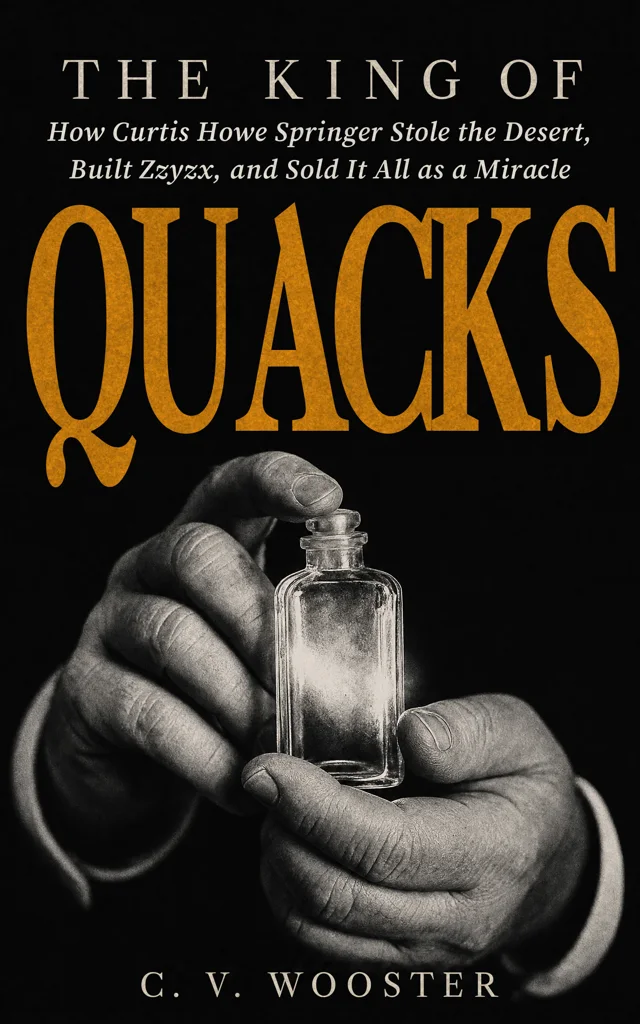
It is worth remembering who was doing the naming. Springer described himself, in a 1967 interview quoted by the Los Angeles Times, as "basically a salesman, a Methodist preacher, vitamin salesman and resort owner." He was not a licensed physician and not an ordained minister. In 1969 the American Medical Association would call him the "King of Quacks." The name Zzyzx was one more product, and a very durable one.
How the word got onto maps
A made-up word on a resort sign does not automatically become a place name. Zzyzx got there in stages.
According to the wordplay journal Word Ways, the name first reached the wider world of language enthusiasts through Dmitri Borgmann's 1967 book Beyond Language, which listed "Zzyzx Springs." Borgmann later said he found it on an old, undated road map of San Bernardino County published by the Automobile Club of Southern California. Atlases followed. The 1973 Hammond Ambassador World Atlas labeled the spot "Zzyzx," and the 1976 Rand McNally Commercial Atlas did the same.
By then Springer was gone. The Bureau of Land Management removed him on April 11, 1974, after years of litigation over whether his mining claims gave him any right to run a resort on public land. But the name stayed behind, and so did the road he had graded from the highway to the springs.
Official at last: June 14, 1984
On June 14, 1984, the U.S. Board on Geographic Names approved "Zzyzx" as the name of the settlement and "Zzyzx Spring" as the name of the water feature, as Word Ways reported. That decision is why the name appears in the federal Geographic Names Information System today, and why Zzyzx is often described as the alphabetically last place name in the United States.
The timing has an irony to it. Ten years after the government removed Springer from the land, it formally adopted the word he invented to sell it. Springer died in Las Vegas on August 19, 1985, a little more than a year later.
Why the sign still gets attention
The Zzyzx Road exit sign has become a minor landmark of its own. The Mojave Project notes that it has inspired or lent its name to horror movies, a literary journal, a band, songs, a fictional company on television and an art exhibit. Michael Connelly set part of his 2004 Harry Bosch novel The Narrows there. Reader's Digest named Zzyzx the most difficult-to-pronounce place name in California.
There is something fitting about that. Springer understood that a strange word creates curiosity, and curiosity brings people down the road. Eighty years later, the same sign is still doing the job he built it for, only now the people who take the exit find a research station and a quiet lake instead of a sermon and a sales pitch.
If you take the exit
Zzyzx Road runs about four and a half miles south from I-15 to the old resort site on the western edge of Soda Dry Lake. The road is part paved and part dirt. At the end, the National Park Service maintains a parking area, picnic tables and the short Lake Tuendae Trail, open during daylight hours. The buildings across the road from the lake belong to the California State University Desert Studies Center and are closed to the public without a reservation. Our visiting guide covers the details.
So say it with confidence: ZY-zix. Then remember that the word was invented by a man who sold baking soda over the radio, and that the government he fought for thirty years ended up making it official.
Sources
- Zzyzx, California. Wikipedia (pronunciation; Borgmann 1967; Hammond 1973; Rand McNally 1976; U.S. Board on Geographic Names approval June 14, 1984, citing A. Ross Eckler, "Zzyzx," Word Ways 29:1, Feb. 1996): en.wikipedia.org/wiki/Zzyzx,_California
- Cecilia Rasmussen, "Zzyzx: An Unlikely Home of Hucksterism and Miracle Cures," Los Angeles Times, June 16, 2002: www.latimes.com/archives/la-xpm-2002-jun-16-me-then16-story.html
- Charles Hillinger, "Zzyzx Rises Above Its Shady, Colorful Past," Los Angeles Times, Sept. 30, 1990: www.latimes.com/archives/la-xpm-1990-09-30-vw-2058-story.html
- Aurora Tang, "Zzyzx: Revisiting Doc Springer's Boulevard of Dreams," The Mojave Project (2015): mojaveproject.org/dispatches-item/zzyzx-dr-springer/
- Curtis Howe Springer. Wikipedia (birth and death dates; AMA "King of Quacks," 1969): en.wikipedia.org/wiki/Curtis_Howe_Springer
- National Park Service, "Lake Tuendae Nature Trail," Mojave National Preserve: www.nps.gov/moja/planyourvisit/lake-tuendae-nature-trail.htm
Spotted an error? Tell us and we will correct it.