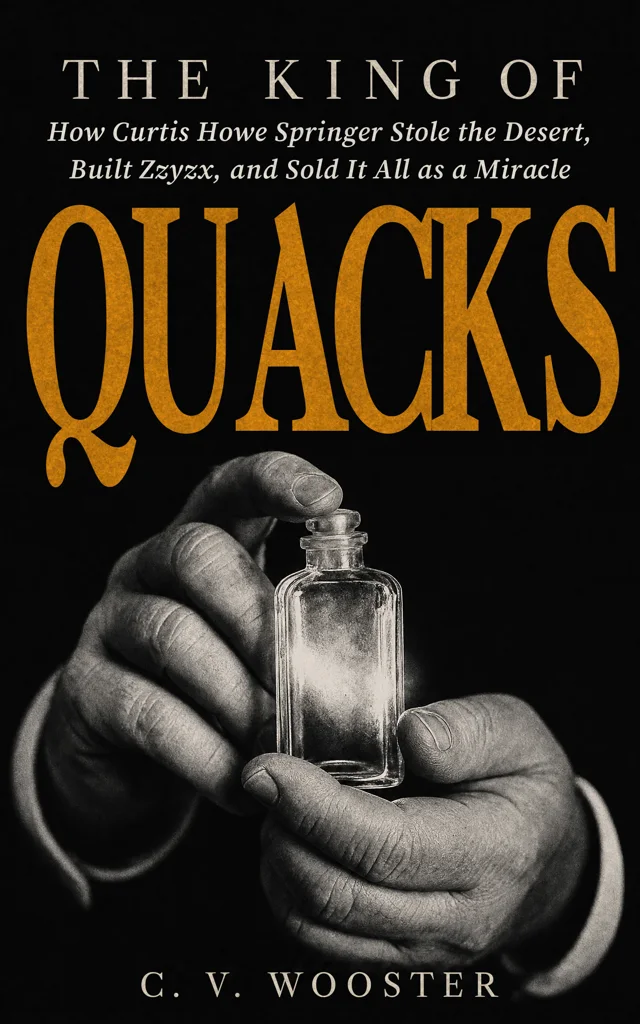
For thirty years, Curtis Howe Springer's voice came out of American radios with gospel music, folksy philosophy and a pitch. Send a donation, and a tin would arrive in the mail. The products had wonderful names: Antediluvian Tea, Hollywood Pep Cocktail, Re-Hib, Manna, Zy-Crystals, Mo-Hair. Springer, who described himself as "the last of the old-time medicine men," promised relief for complaints large and small.
This post looks at what he sold and what investigators, journalists and former staff later said was actually inside. Where the sources disagree or are thin, we say so.
The product line
The fullest list in a modern source comes from Aurora Tang's 2015 history of Zzyzx for The Mojave Project, which describes the products in Springer's own marketing language:
- Antediluvian Desert Herb Tea, described as a botanical laxative of herbs, roots and barks.
- Acidine, "nature's normalizer for acid stomachs."
- Hollywood Pep Cocktail, which supposedly contained "concentrated vital food energy" and was meant to be sprinkled over food.
- Manna, "a blend of ten different fruits and vegetables."
- O-M-R, "one-minute relief for indigestion."
- RE-HIB, "a thorough acting anti-acid."
- Zy-Crystals, a combination of Epsom salts and salt harvested from Soda Dry Lake, to be applied to the scalp while holding one's breath.
The Los Angeles Times added a few more details in 2002: Antediluvian was a peppermint-flavored desert herb tea, and the catalog included a $25 cure-it-yourself hemorrhoid kit. The paper also described Springer's instructions for Zy-Pac, the mineral salts collected from the lake bed: rub them over the scalp, bend over and hold your breath as long as possible. The flush in the cheeks and scalp, Springer claimed, proved the salts were working. A simpler explanation is that anyone who bends over and holds their breath turns red.
What the AMA found
The American Medical Association had been watching Springer since the 1930s, long before Zzyzx existed. Its Bureau of Investigation ran a column in the Journal of the American Medical Association on September 14, 1935 (vol. 105, no. 11, p. 900) under the title "Curtis Howe Springer: A Quack and His Nostrums." According to Wikipedia's summary of that report, the AMA found that Re-Hib was mostly baking soda and that Antediluvian Tea was "a crude mixture of laxative herbs." The report also concluded that a thorough search failed to show Springer had ever graduated from any reputable college or university, medical or otherwise.
None of that is exotic. Baking soda, sodium bicarbonate, really does neutralize stomach acid for a while; it is the active ingredient in some ordinary antacids. Laxative herbs really do work as laxatives. The fraud lay in the claims and the credentials attached to them, not in any secret poison.
"Ten percent crust, ninety percent Epsom salts"
The National Park Service, which now manages the land around Zzyzx as part of Mojave National Preserve, tells the story of the resort on its website. One detail stands out: a former employee described Springer's formula as 10 percent crust from Soda Lake and 90 percent Epsom salts. The NPS also reports that over thirty years the operation shipped more than four million packages, including Antediluvian Herb Tea, Nerve Cell Food and Hollywood Pep Cocktail.
Charles Hillinger of the Los Angeles Times, who covered Springer for decades, described the drinkable "potions" in 1990 as concoctions of celery, carrot and parsley juice, shipped to all fifty states and overseas. The 2002 Times history lists the claimed sources of curative power as carrots, celery, turnips, parsley and brown sugar.
The claims got him in trouble
Vegetables and Epsom salts are harmless enough. Claims are another matter. In November 1968, according to The Mojave Project, Springer was arrested on a sixty-five-count state warrant for false advertising and misrepresentation, in a case brought by the California Department of Public Health's Bureau of Food and Drug Inspections. The state's theory was that he was marketing ordinary foods such as celery, carrots, parsley and turnips as health supplements with unfounded therapeutic claims, and selling untested treatments like the hemorrhoid kit. The Mojave Project says he pleaded guilty to eight counts. The Ninth Circuit's 1972 opinion gives a higher figure: his convictions, "some on pleas of guilty," included "eighteen counts of false advertising concerning remedies for hemorrhoids, heart disease, 'nerves,' thyroid and goiter" plus food-misbranding violations (478 F.2d 43, 46 n.2).
The Los Angeles Times reported in 2002 that he was convicted of falsely advertising products including Mo-Hair, which he claimed would cure baldness. The paper quoted Dr. Murray Zimmerman, who had testified against the baldness cure, recalling that Springer paid his $2,500 fine "like it was a $2 traffic ticket" and was back on the radio that night. Wire coverage in 1976 summed up Springer's range of promises as everything "from sore toes to cancer."
Why this matters now
It is easy to laugh at a man who told people to hold their breath to make salt work. But the people who sent money to Zzyzx were often older, often sick and often let down by medicine that could not fix what was wrong with them. Springer offered attention, certainty and a tin you could hold. The ingredients were cheap. The trust was not.
The modern versions are easy to find. The Federal Trade Commission warns consumers to be suspicious of products that claim to cure a wide range of unrelated diseases, rely on personal testimonials instead of evidence, or promise quick, "miracle" results. Springer's catalog checked every box. If a product's main evidence is a charming voice and a story, it is worth remembering what was in the tins at Zzyzx.
Sources
- Aurora Tang, "Zzyzx: Revisiting Doc Springer's Boulevard of Dreams," The Mojave Project (2015): mojaveproject.org/dispatches-item/zzyzx-dr-springer/
- Cecilia Rasmussen, "Zzyzx: An Unlikely Home of Hucksterism and Miracle Cures," Los Angeles Times, June 16, 2002: www.latimes.com/archives/la-xpm-2002-jun-16-me-then16-story.html
- Charles Hillinger, "Zzyzx Rises Above Its Shady, Colorful Past," Los Angeles Times, Sept. 30, 1990: www.latimes.com/archives/la-xpm-1990-09-30-vw-2058-story.html
- National Park Service, "Zzyzx," Mojave National Preserve: www.nps.gov/moja/learn/historyculture/zzyzx.htm
- AMA Bureau of Investigation, "Curtis Howe Springer: A Quack and His Nostrums," JAMA 105(11):900, Sept. 14, 1935. DOI: doi.org/10.1001/jama.1935.02760370056027
- Curtis Howe Springer. Wikipedia (summary of the AMA findings): en.wikipedia.org/wiki/Curtis_Howe_Springer
- Federal Trade Commission, "Common Health Scams": consumer.ftc.gov/articles/common-health-scams
Spotted an error? Tell us and we will correct it.